It started with one girl . . . and $40

Meet Student Zero - our Brand Story. . .
Sometimes you just trip over something that compels you to act. We were in Kathmandu for the first time in 2016. Sitting with Bikash — the president of the local NGO we had come to meet — when a young teenage girl knocked on the door - interrupted.
She spoke softly with him. We didn't understand the language but we understood everything else. The way she stood. The look on her face. Fear, shame, desperation, and something that looked like a last hope. Bikash was so gentle with her. Patient, present, respectful, compassionate. He took her seriously. She left a few minutes later with the office manager and we asked Bikash what had just happened.
She needed $40. Her school wouldn't let her sit her final exams unless the exam fee was paid upfront. She had made it through the entire year — through everything her family carried every day — and $40 was the wall between her and graduation.
We paid it. Of course we paid it. How could you not.
But we couldn't stop thinking about her afterward. And we wondered how many other families were navigating these same walls — exam fees, school supplies, small amounts of money that meant everything. We started asking questions. The answers stayed with us long after we flew home.
Back with Bikash and Bijata (story below) in 2018 and this girl became the beginning of all of this. We call her PEP Student Zero. She is the reason PEP exists, the reason we started calling our donors Helpers, and the reason 90 children in Kathmandu are in school today.
We are deeply grateful for this moment. . . it still moves our hearts.
Now, with 8 school years completed - 9th year stats. . .
Children Enrolled
90
Grades passed
450
14
Graduates
56 Schools
all close to home
2018
Operating Since
82
Life-skills Seminars

Meet DB
DB runs PEP on the ground in Kathmandu. Every month he visits each student at their school and at their home — in person, on his scooter, through the traffic and narrow lanes of the city.
This monthly contact is the backbone of how PEP works. If a child is struggling, DB knows immediately. If something's off at home, he sees it. He can encourage, advocate, arrange tutoring - intervene before a small problem becomes a big one.
It's a lot of ground to cover. He does it every month without fail.

A PEP family home
This is a typical home for a PEP family. One room. A small kitchen area along one wall. No running water. A shared washroom down the hall.
This mom is a widow. She lives here with her young daughter and two nieces. Her monthly rent runs about the same as her daughter's school fees — which gives you a sense of the financial tightrope these families walk every day.
She's smiling because her daughter is in school. PEP is vital to this home.

Classroom
This is what a Kathmandu urban school classroom looks like. This one is on the quieter side — many are considerably more crowded.
Where possible, PEP steers families toward schools that teach in English. It isn't always an option, but when it is, it makes a real difference. English language education opens up a much wider range of employment opportunities as the kids grow older.
Bijata is the Executive Director of Sundar Dhoka Saathi Sewa — SDSS — the registered humanitarian NGO in Nepal that runs PEP on the ground. SDSS was founded by her husbands Bikash's family and their local church. SDSS has served Nepal's most vulnerable people for years, with a particular focus on those living with disabilities. "for the least of these" is their brand identity, and they live it daily.
Bijata holds three Masters degrees, fluent in English, a lifelong learner and gifted leader.
Earlier in her career she managed the Nepali operations of a large international NGO running education scholarships for children. That experience gave her an unusually clear view of what works in education sponsorship programs — and more importantly, what doesn't. The architect of PEP, she brought that knowledge directly to the table in the design of PEP and its strategy.
In her own words: "The PEP strategy was designed to address the limitations of other education sponsorship programs."
It shows.
Bijata is also the widow of Bikash — the man you met in the previous story. The one who sat patiently with a frightened teenage girl and cared. That same spirit runs through everything SDSS does.
We have worked alongside Bijata and her team for ten years. In that time we have made regular trips to Kathmandu to see the work firsthand and oversee the PEP program on behalf of our donors. What we have seen, consistently, is an organization that is transparent, compassionate, well governed, and deeply committed to the people they serve. Your gifts are in good hands.

The Visionary Behind PEP - Bijata Adhikari

PEP is a ministry program of Sundar Dhoka Saathi Sewa (SDSS), a non-denominational registered Nepali NGO. SDSS is licensed under the Social Welfare Council of Nepal.

Stories of PEP & Nepal
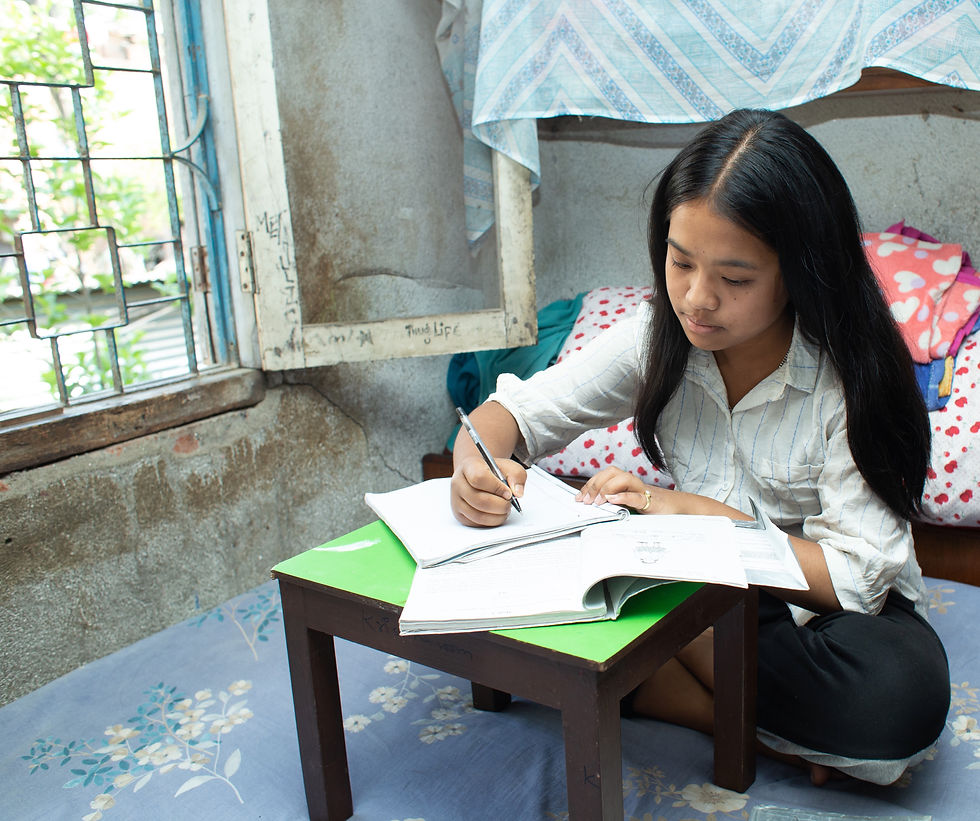
A study centre for home
This small study desk is about two feet high. Each PEP student receives one.
It sounds simple. But in a one-room home where a family of four eats, sleeps, and lives — there's nowhere to do homework. No table. No quiet corner. The kids were working on their beds or the floor.
So we changed that. A small desk and a little bookshelf. Nothing fancy. But now there's a place in the home that belongs to "learning". The families love it. The kids use it every day.

Where they go to school
Kathmandu is actually three cities that together form one sprawling urban valley of about three million people. Schools are plentiful but crowded and under-resourced.
PEP works with each family individually to find the right school for their child. Right now our 90 students attend 56 different schools scattered across the metro area.
That's 56 schools DB or Surakcha visit every single month. In Kathmandu traffic, on a scooter, that's no small thing.

The disadvantaged
This is a PEP mom with her daughter and a friend. An untreated childhood injury left her with a minor physical limitation — but in Kathmandu's job market, that's enough stigma (Karma) to quietly narrow her options.
Finding steady work is a constant challenge. Making ends meet takes everything she has.
Her daughter is in PEP. School fees are covered. She stays in school.

Meet Surakcha
Surakcha is the second member of the PEP team in Kathmandu. She and DB run the program together.
She brings a Masters degree and a natural gift for technology to a program that needs both. Student records, program tracking, communications, parent engagement — Surakcha holds a lot of the operational threads together behind the scenes.
Between the two of them, DB and Surakcha are PEP on the ground every single day. The strategy only works because they make it work.

Without education. . .
This young man is working. He'll push that bicycle through the streets of Kathmandu all day, selling household goods, hoping for customers. The enterprise likely belongs to someone else. He shares whatever profit comes.
This is a common story for those who never made it through school. Day labour, street vending, piece work. It's honest work — but it's also a ceiling with no way through.
This is what PEP is trying to change.

Life skills enrichment
This is a group of PEP students after one of their enrichment sessions. These gatherings happen throughout the school year and cover non-academic life skills — things the school curriculum doesn't teach and most PEP parents aren't equipped to teach at home.
The sessions are structured and age appropriate. The kids clearly enjoy them. More importantly, the things they learn here stay with them long after the school year ends.
Two minutes. One child. A window into what a typical day in PEP looks like - home, school, family, and the people who make it all work.
